[[{“value”:”
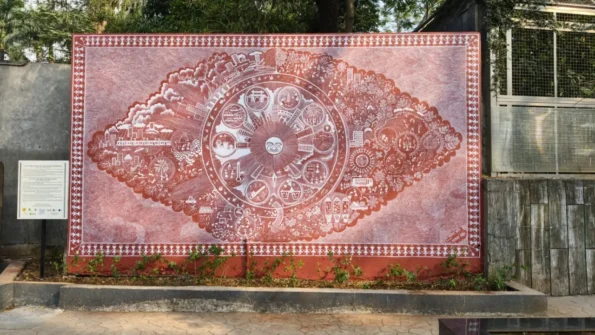
In an effort to simplify climate conversations and bring them closer to everyday experiences, a 22-foot Warli mural art that aims to simplify climate conversations and make it accessible, relatable, rooted in everyday experiences was unveiled at the Veermata Jijabai Bhosale Botanical Udyan and Zoo.
Created by two young Mumbai based adivasi artists Dinesh Barap and Akash Bhoir, the artwork titled — Two Paths, One Circle: A Warli Story of Climate, Community, and Choice uses the traditional Warli art form to tell the climate change story.
The wall art was unveiled earlier this February by Abhijit Ghorpade, director, Maharashtra State Climate Action Cell), Dr Sanjay Tripathi, director, Veermata Jijabai Bhosale Botanical Udyan & Zoo), and Dr. Komal Raul, Deputy Director, Veermata Jijabai Bhosale Botanical Udyan & Zoo).
This artwork, which was a part of the Mumbai Climate Week, held between February 17 to 19, is an initiative by Asar Social Impact Advisors an environment organisation under its Climate Culture Collective project and was undertaken in collaboration with the Maharashtra State Climate Action Cell, BMC, and Veermata Jijabai Bhosale Botanical Udyan and Zoo.
The entire Warli art represents two paths. One side reflects the climate realities we are already living with- rising heat, polluted air and waterbodies, shrinking forests and open spaces, rising sea-levels and coastal flooding, droughts and agriculture under stress. These problems affecting farmers, fisherfolk, city dwellers, children, and wildlife alike are clearly depicted on the mural.
The other side offers something equally important—solutions. It depicts how we can manage waste responsibly, protect our green areas and forests, adopt cleaner energy, and care for our shared spaces. These scenes remind us that climate action does not begin in policy documents alone—it begins with the everyday choices made by people working together.
Running along the border of the mural is a continuous circle of people holding hands in a traditional Warli dance. It tells us that whether harm or healing, the future is shaped collectively—whether it is destruction or protection, climate action is always about people. The same hands that harm can also heal it, when communities choose to act together.
Since the wall is located near the leopard enclosure, the zoo authorities expect high footfalls and the project aims to catch the attention of visitors —especially children to initiate climate conversations.
“}]]