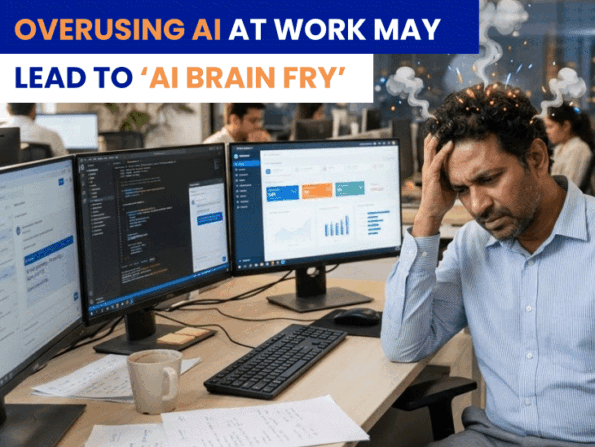
Artificial intelligence tools are quickly becoming a normal part of the modern workplace. Whether you are a coder, marketer, accountant, or manager, chances are you use AI in some form, sometimes even multiple tools at the same time. These tools promise faster work and higher productivity. But a new study suggests that constantly working with AI systems may also come with an unexpected downside: mental exhaustion. A recent study published by Harvard Business Review has found that excessive use of AI tools at work can leave employees mentally drained, a phenomenon researchers call “AI brain fry.” AI is helping us work faster, but it may also be exhausting our brains
What exactly is ‘AI brain fry’? ‘AI brain fry’ refers to mental fatigue caused by constantly monitoring, managing, and interacting with AI tools. Instead of doing tasks directly, many workers now spend time checking AI outputs, correcting mistakes, switching between tools, and reviewing results. Over time, this constant oversight can overload the brain. In the study, researchers surveyed 1,488 workers in the United States to understand how AI tools are affecting their daily work. Around 14% of participants who regularly used AI at work reported experiencing this kind of mental exhaustion. Many described it as a strange sensation that felt like: Researchers believe this happens because the brain is forced to process large amounts of information and constantly switch between tasks. Why AI tools can become mentally tiring On paper, AI tools are designed to make work easier. But in many cases, workers end up managing several AI systems at once. For example, one tool might generate content, another might analyse data, and another might help with decision-making. Instead of simplifying work, juggling multiple systems can increase the cognitive load on employees. One engineer in the study described the experience clearly: I end each day exhausted—not from the work itself, but from managing the work. Six worktrees open, four half-written features, two ‘quick fixes’ that spawned rabbit holes, and a growing sense that I’m losing the plot entirely. They added: I was working harder to manage the tools than to actually solve the problem. Is AI brain fry the same as burnout?
Not exactly. Traditional workplace burnout usually involves emotional exhaustion, frustration, and negative feelings toward work. AI brain fry, however, is more about cognitive overload. It happens when workers must constantly monitor and manage multiple AI systems, which stretches the brain’s attention and memory capacity. Because of this difference, researchers say AI brain fry may not always show up in standard burnout surveys, making it harder for companies to detect. Also read: Elon Musk unveils ‘Macrohard’ to run companies without humans
Which professions are most affected? The impact of AI brain fry is not the same across all industries. Some roles that heavily rely on digital tools appear to be more affected than others. According to the study: Interestingly, some professions reported much lower levels. Only 5.6% of legal professionals said they experienced this issue. Leadership and product management roles were also relatively lower, with around 8.6% reporting AI brain fry. The hidden cost for businesses Mental fatigue caused by AI oversight doesn’t just affect individuals, it can also impact organisations. The study found that employees experiencing AI brain fry showed: Workers dealing with intense AI usage were also 39% more likely to consider quitting their jobs compared to those who did not experience this issue. This suggests that while AI can boost productivity, overusing it without proper workflows may reduce the quality of decisions and increase employee stress. Also read: Mobile data usage in India could soon get taxed: Govt exploring plans to charge ₹1 per GB to generate revenue
AI isn’t always the problem Despite these concerns, the study also highlighted an important point: AI itself is not necessarily harmful. When AI tools were used mainly to handle repetitive and boring tasks, workers actually reported lower burnout level, about 15% lower on average. Employees in such cases also felt more engaged at work, less stressed, and more connected with colleagues
Lesson for the AI workplace As AI becomes deeply integrated into everyday jobs, the challenge will be finding the right balance. AI can make work faster and more efficiently. But if employees are forced to constantly supervise multiple systems, the benefits may come at the cost of mental overload.