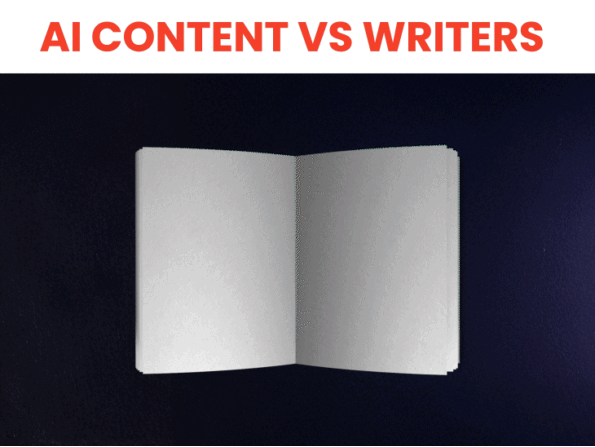
Imagine picking up a book written by thousands of well-known authors… and finding almost nothing inside it. That is exactly what happened at the London Book Fair, where around 10,000 writers released a nearly empty book titled “Don’t Steal This Book.” The unusual publication is not a mistake; it is a protest. The blank pages are meant to send a clear message to governments and tech companies: if artificial intelligence keeps using authors’ work without permission, writers may be left with nothing.
Why are authors protesting Many writers and artists around the world are increasingly worried about how AI models are trained. Companies developing AI systems, such as OpenAI, Google, and Anthropic, train their models using massive datasets. These datasets often include books, articles, images, and other online content, much of which is protected by copyright. Writers argue that their work is being used to train AI tools without their permission and without any payment. Because of this, thousands of authors decided to stage a creative protest by publishing a book that contains no stories or chapters, only a list of the writers who signed the project. Why is the book empty The book was organised by Ed Newton-Rex, CEO of the non-profit organisation Fairly Trained and a vocal advocate for creators’ rights. Explaining the idea behind the project, he wrote on X (formerly Twitter). At the back of the book, the message becomes even clearer. It reads: The UK government must not legalise book theft to benefit AI companies It also warns: If they don’t, this is what we’ll be left with: empty pages, writers without pay, and readers deprived of the next book they’ll love.
Also read: Ukraine opens battlefield data to train AI drones with allies: New systems aim to help identify targets
Why is this protest happening now The protest comes just before a major discussion in the UK Parliament about copyright laws. The government is considering changes that could allow AI companies to train their models on copyrighted material unless creators specifically opt out. Critics say this system would be unfair because it places the burden on authors to protect their work rather than requiring companies to ask for permission first. The empty book was distributed at the London Book Fair to pressure lawmakers ahead of the debate. About 1,000 physical copies of the book were handed out to attendees to raise awareness and support for the movement. Famous writers backing the campaign The campaign includes some of the biggest names in literature. Among the authors supporting the protest are Nobel Prize-winning novelist Kazuo Ishiguro, historical fiction writer Philippa Gregory, and Richard Osman, a popular British author and television presenter. Other well-known writers such as Jeanette Winterson and Alan Moore, the creator of Watchmen and V for Vendetta, have also joined the campaign. Their argument is simple: AI systems should not be built using millions of books without the authors’ knowledge. A growing global debate about AI and copyright The issue is not limited to the UK. Around the world, writers, artists, and media organisations are raising concerns about how their work is being used in AI training. Training large language models requires huge amounts of data, which often comes from the open internet. That data can include copyrighted material such as novels, news articles, research papers, and artwork. Because of this, several lawsuits have already been filed against AI companies in both Europe and the United States. In one notable example last year, Anthropic, the company behind the Claude AI system, reportedly paid $1.5 billion to settle a lawsuit filed by authors who claimed the company used pirated copies of their books for training. Also read: Using too much AI at work leads to ‘AI brain-fry’: Harvard study finds many negative effects
Writers push for ‘human-authored’ labels Alongside the protest, The Society of Authors, one of the largest writers’ unions in the UK, has launched a new initiative called the “Human Authored” label. Under this system, writers can register books created entirely by humans after 2020. These works will be added to a database, and authors can place a Human Authored logo on their books. The goal is to help readers identify genuinely human-written works in a future where AI-generated content becomes more common. A symbolic protest with a clear warning The empty book may not contain a story, but it carries a powerful message about the future of creativity. By publishing a book filled mostly with blank pages, thousands of writers are trying to show what could happen if copyright protections weaken in the age of artificial intelligence.
Their warning is simple: without fair rules for AI, the next generation of books may never be written.