
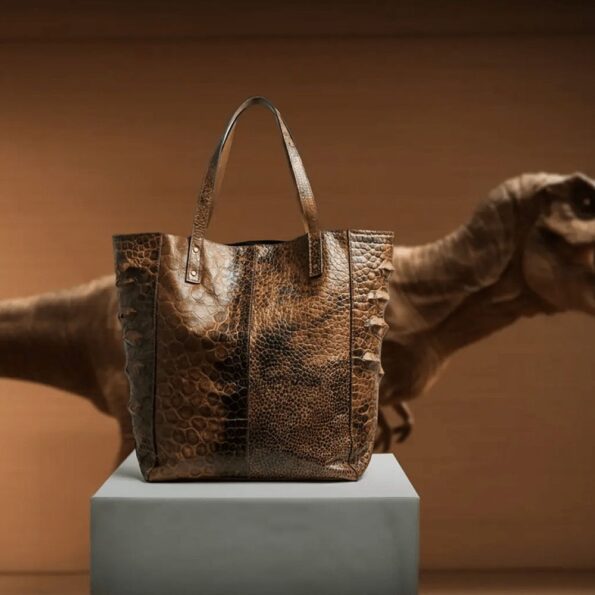
Around 66 million years ago, the mighty Tyrannosaurus rex ruled the Earth as one of the most feared land predators. Today, scientists and designers are exploring a surprising idea: turning this ancient creature into a luxury handbag material without harming any animals. Researchers are working on lab-grown leather inspired by fossil fragments of T. rex, aiming to create a new type of sustainable and cruelty-free fashion. If successful, it could change how luxury materials are made in the future. A new kind of leather inspired by dinosaurs A team of scientists and creative experts is developing leather using collagen structures linked to T. rex fossils. Collagen is a key protein found in skin and is essential for making leather. Professor Che Connon, a tissue engineering expert at Newcastle University, says the project shows how ancient biology could help create modern materials. According to him, the biggest challenge growing leather from cells has already been solved. The next step is applying existing technologies to recreate collagen-based material inspired by prehistoric life. If successful, this would be the first leather ever modeled on an extinct species. Who is behind the project? The initiative is a collaboration between: Together, they are trying to combine ancient protein science with modern bioengineering to produce a new generation of luxury materials. Their goal is to launch a flagship luxury accessory by the end of 2025. How scientists plan to make T. rex leather Instead of using real dinosaur skin which no longer exists researchers are studying collagen fragments preserved inside fossilized bones. They then: This process allows cells to organize themselves without artificial scaffolding, forming structures similar to real leather. Scientists spent nearly 15 years in university research and several more years in industry developing this technology. Why this material could change the fashion industry The lab-grown material is designed to be: Traditional leather production often contributes to deforestation and chemical pollution. Lab-grown alternatives could reduce these problems significantly. Experts say the technology might also be used in other industries later, including automotive manufacturing. Not everyone is convinced it will work Despite the excitement, some scientists are skeptical. One major concern is that no complete T. rex DNA has ever been found. DNA usually breaks down quickly after death, and the oldest preserved DNA discovered so far is about 2 million years old far younger than dinosaurs. Since T. rex disappeared 66 million years ago, some researchers argue it’s impossible to recreate its genetic material accurately. Others point out that fossils rarely preserve dinosaur skin, which is normally needed to study leather structure directly. Could it still be possible? Supporters of the project say critics may be misunderstanding the process. Professor Connon explains that leather is made from collagen, not skin itself. Scientists can study collagen fragments preserved inside fossilized bones and blood vessel structures, which share similarities with skin tissue. By combining these fragments with modern engineering methods, researchers believe creating dinosaur-inspired leather is achievable. Still, some experts say the technology is in its early stages and any real product may take time and could be expensive at first. More than just a fashion statement Beyond luxury accessories, the project highlights how science can create completely new materials never seen before in nature. Researchers believe similar methods could someday produce: Interestingly, dinosaurs once survived extreme environmental conditions something scientists think could inspire materials suited for today’s changing climate. A glimpse into the future of sustainable luxury Whether T. rex leather becomes widely available or not, the idea represents a bold step forward in bioengineered fashion. It combines ancient biology with modern science to answer a simple question: Can materials from the distant past help build a more sustainable future? If the answer is yes, your next luxury handbag might carry a story that began millions of years ago.