
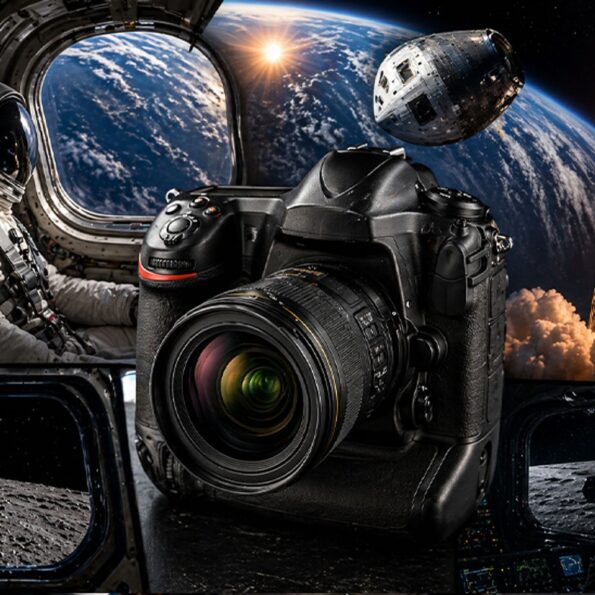
Artemis II carried humans after 50 years on a historic space flight around the Moon. Naturally, the Orion spacecraft was packed with 15 cameras installed inside the spacecraft and 17 carried by the crew to capture every important moment. These cameras are already producing stunning images. But what’s really surprising is the type of camera NASA chose for such a major mission. Instead of relying only on the latest mirrorless technology, NASA picked an older DSLR camera as its main shooter. Let’s understand why. NASA’s trusted camera partner for decades
NASA’s connection with Nikon goes back a long way. The first Nikon camera used in space flew during Apollo 15 in 1971, based on the Nikon Photomic FTN. Earlier missions mostly relied on Hasselblad cameras, which were once known as the “space cameras” of the Apollo era. However, as space photography moved from film to digital systems, NASA increasingly began trusting Nikon cameras instead. Over the past five decades, Nikon cameras have supported more than 100 space missions. This trust comes from careful engineering. Nikon modified cameras with: These changes made them reliable tools beyond Earth. The Artemis program’s special camera upgrade
In 2024, NASA officially partnered with Nikon for the Artemis missions. Engineers tested the Nikon Z9 mirrorless camera to prepare it for use on the Moon. The camera received several upgrades, including: So, why is NASA still using the older Nikon D5?
Here’s the biggest surprise: the primary camera on Artemis II isn’t the newer Z9 it’s the older Nikon D5 DSLR. That might sound strange, especially since DSLRs are slowly disappearing from today’s consumer camera market. They’re heavier and older than mirrorless cameras, which usually makes them less ideal for space missions. But NASA had a strong reason. The Nikon D5 is still one of the best cameras ever made for low-light photography. Its ISO range goes up to 3,280,000, nearly 30 times higher than the Z9’s maximum ISO of 102,400. This makes it extremely useful when capturing dark scenes in spacelike the far side of the Moon. In fact, NASA recently shared a beautiful image of Earth taken from the spacecraft using the D5 at ISO 51,200. Old tech, smart choice Even though mirrorless cameras represent the future, NASA proved that reliability and performance matter more than trends in space missions. For Artemis II, the combination of the modern Z9 and the proven D5 ensures astronauts can capture both bright lunar views and extremely dark space environments with confidence.