
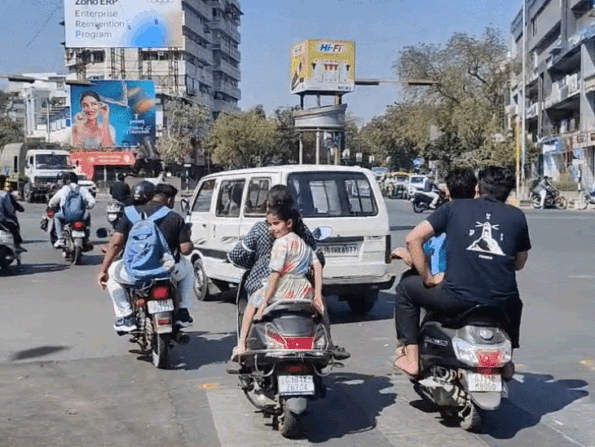
To tackle the city’s never-ending traffic woes, the Ahmedabad Municipal Corporation (AMC) has proposed a massive technological overhaul in its budget for 2026-27. The civic body plans to implement an Adaptive Traffic Control System (ATCS) at a project cost of Rs 899 cr, aiming to replace static signal timers with Artificial Intelligence (AI). While the administration is willing to spend heavily to modernise the city’s junctions, experts and citizens alike are raising questions about implementation amidst several infrastructural challenges and complications. How the ATCS will work Unlike traditional signals that operate on fixed timers, ATCS utilises vehicle detection sensors, intelligent controllers, and a communication network linked to a central server. It gathers real-time data on traffic density at junctions, and uses AI-based software to adjust signal timings instantly. Moreover, the signals will be synchronised so that once a vehicle gets a green light at one junction, subsequent intersections along the corridor also turn green, enabling smoother movement. Emergency vehicles such as ambulances will be provided green corridors. Authorities say the system will also make it easier to penalise traffic rule violators. Indirect benefits include reduced fuel consumption and a likely decline in road accidents. AMC’s plan for the tech integration HT Mehta, AMC’s additional city engineer (traffic), confirmed to Bhaskar English that the system will cover 373 junctions across the city. Mehta said that fibre optic cabling will be the first step in building the integrated system. Mehta provided the update regarding this technology: The civic body is preparing a Request for Proposal (RFP) for implementation. Fibre installation could take up to 1.5 years, while full-scale operations may take up to three years. Sources indicate that AMC is willing to commit a significant portion of its capital expenditure toward resolving the growing traffic concerns before the Commonwealth Games in 2030. Factors of concern Despite the optimism, concerns remain regarding the system’s viability in local conditions. Dr Pravin Kanabar of the Active Traffic Consultative Committee (ATCC) welcomed the move, pointing out that similar systems have proven successful internationally, but warned that technology cannot work in a silo. Kanabar noted that Ahmedabad’s roads suffer from specific anomalies—waterlogging, untraceable underground utilities, and rampant encroachments. “The ATCS technology will have to persist in such an environment,” he added. Commuters’ take on traffic concerns For the daily motorists, the primary concern remains spending prolonged periods at the signals under the heat. “Mandatory long red lights become a massive trouble, especially during scorching summers,” said Ayan, a localite. Another commuter, Divyang, echoed this fear, predicting that 2-to-3-minute signals would be a ‘menace’ in the afternoon once the ‘peak summer’ arrives. Others pointed out that technology can only do so much against human error. A motorist highlighted that without curbing basic violations—such as rash driving, lane cutting, and ignoring helmets—even the smartest signals might struggle to organize the chaos during the peak 6 PM to 7 PM rush.