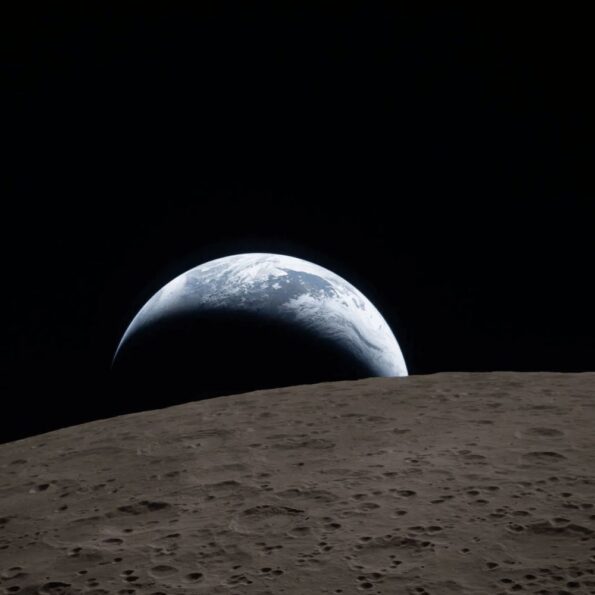
As the world watches the final days of NASA’s historic Artemis II mission, humanity stands at a profound moment in space exploration. For the first time in over half a century, humans have ventured past low Earth orbit, traveling deeper into space than ever before. But as the Orion spacecraft and its four-person crew begin their final approach back to Earth, one of the most intriguing questions surrounding lunar exploration remains: What about the far side of the Moon? Artemis II is not just a flight test; it is the first chapter in a new era of lunar presence. This mission is laying the essential groundwork that will answer that very question and eventually put human boots not only back on the Moon, but on its least-explored, most mysterious half. What is the Far Side of the Moon? When we look at the Moon from Earth, we always see the same face. This happens because the Moon rotates at the same speed as it orbits Earth a process called tidal locking. As a result, one half always faces us (the near side), while the other half remains hidden from direct view. This hidden half is known as the far side of the Moon. Many people mistakenly call it the “dark side” of the Moon. But that’s not correct. The far side receives just as much sunlight as the near side. The reason we don’t see it is simply because it faces away from Earth. The far side looks very different from the Moon’s near side. It has: Because of these features, scientists believe the far side holds valuable clues about the Moon’s early formation and the history of our solar system. Why has no human reached the Far Side of the Moon? Although astronauts landed on the Moon during the Apollo missions, all landings happened on the near side, not the far side. The biggest reason is communication difficulty. Spacecraft and astronauts depend on continuous radio contact with Earth. But when a spacecraft moves to the far side of the Moon: During the Apollo missions, even orbiting spacecraft briefly lost contact whenever they passed behind the Moon. To safely land humans on the far side, space agencies must first deploy relay satellites around the Moon. These satellites would act like signal bridges between Earth and astronauts on the surface. Interestingly, robotic missions have already explored the far side. China’s Chang’e-4 spacecraft made history in 2019 by becoming the first mission to land there using a relay satellite system. Human missions, however, require much higher safety standards so they are taking longer to prepare. What did the Artemis II Moon mission achieve? The Artemis II mission is a major step in humanity’s return to deep space exploration. It is designed as the first crewed lunar flyby mission in more than 50 years after the Apollo era. Instead of landing, Artemis II carries astronauts around the Moon and back to Earth. This journey helps scientists test critical systems before future lunar landings. Here’s what the mission achieved: 1. Testing the Orion spacecraft with humans onboard 2. Traveling farther than previous human missions 3. Preparing for future moon landings 4. Strengthening deep-space communication and navigation What is the future of human landings on the Far Side of the Moon? The road to the far side runs through Artemis III, the next mission in the program, which will target a landing near the Moon’s South Pole. This region is the key to all future exploration because it contains vast deposits of water ice within permanently shadowed craters. Water is the fuel for sustainable exploration it can be broken down into oxygen for breathing and hydrogen for rocket propellant. Establishing an outpost
Future human exploration of the far side will follow these critical steps: