
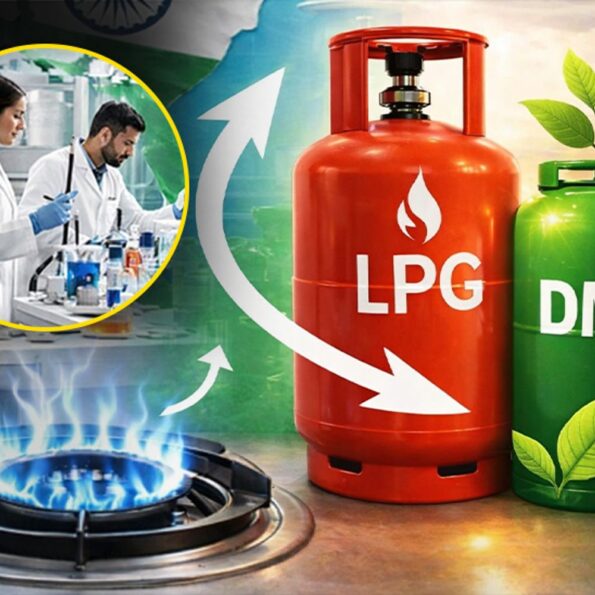
As India continues to rely on imports for nearly 60% of its LPG needs, and global fuel supply chains remain uncertain, finding a reliable local alternative has become more important than ever. In a promising development, scientists at BITS Pilani Hyderabad Campus have created a new method to turn carbon dioxide (CO₂) into a cleaner cooking fuel called dimethyl ether (DME). Turning pollution into cooking fuel The research team, led by Prof. Sounak Roy along with Prof. Satyapaul A. Singh and Prof. B.M. Reddy, developed a patent-protected single-step process that converts captured CO₂ directly into DME. The project received support from the Anusandhan National Research Foundation. This breakthrough not only helps reduce harmful emissions but also supports India’s goal of becoming more energy independent. How the technology works The scientists used simulated flue gas a byproduct released from power plants and combined it with hydrogen produced through water electrolysis. Using specially designed catalytic materials inside a high-pressure reactor, they successfully converted CO₂ into DME in one step. The team carefully adjusted temperature, pressure, and gas ratios to improve efficiency and increase the DME output compared to methanol production. Why DME could replace LPG DME burns much cleaner than traditional LPG. It produces less soot and fewer sulfur oxide emissions, while offering similar heating performance for cooking. Recognising its potential, the Bureau of Indian Standards introduced guidelines in late 2024 allowing up to 20% DME blending with LPG, making it a practical and affordable cleaner fuel option. A step toward cleaner energy independence Another major advantage of this process is that it captures CO₂ directly from power plant exhaust and uses renewable hydrogen, creating both environmental and economic value. The three-year research project began in 2022 with funding of about ₹44.69 lakh. If scaled successfully, this innovation could play a key role in reducing India’s LPG imports while cutting carbon emissions at the same time.