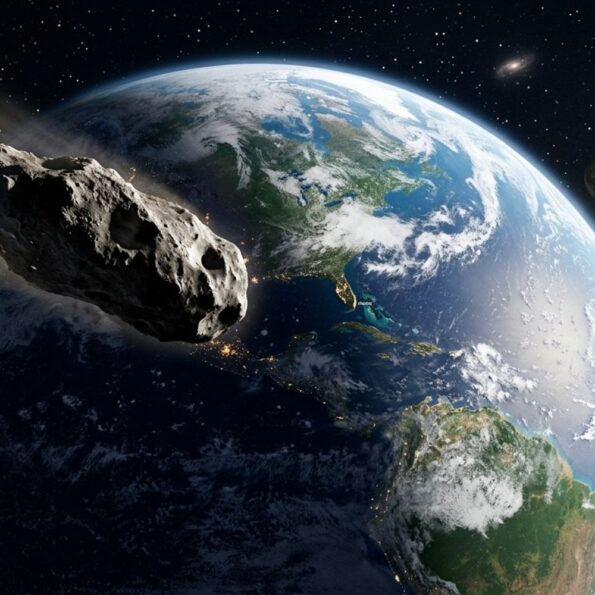
NASA has confirmed that a newly discovered asteroid, named 2026 JH2, will pass unusually close to Earth. The US space agency says the asteroid will safely pass Earth on May 18, 2026, at a distance of about 90,000 kilometers, roughly one-fourth of the distance to the Moon. While the space rock will come closer than many asteroids typically do, scientists say there is no risk of impact. The event is attracting attention because the asteroid was detected only a few days before its approach.
What is Asteroid 2026 JH2? Asteroid 2026 JH2 is a small near-Earth asteroid that crosses Earth’s orbit around the Sun. It was discovered just a few days ago by the Mount Lemmon Survey in Arizona, which helps track asteroids and other objects that pass near our planet. Size of the Asteroid Scientists estimate it is around: These estimates may change as astronomers collect more data. How close will it come? At its closest point, the asteroid will pass just: That may sound alarmingly close, but experts confirm there is zero chance of impact. Why scientists are excited Because 2026 JH2 was discovered only days before its flyby, astronomers are using this event to: These close passes are important for planetary defense research.
Will it be visible? The asteroid will become bright enough to be seen with a small telescope under dark skies, but it will not be visible to the naked eye. The Virtual Telescope Project is expected to livestream the event so people around the world can watch it online. Why was it discovered so late? Small asteroids are hard to spot because they are faint and tiny. Many are only detected when they get close to Earth. That is why space agencies like NASA constantly scan the skies to identify and track such objects. Is there any danger to Earth? No. Asteroid 2026 JH2 will safely fly past Earth and continue its journey around the Sun. For scientists, this is a valuable observation opportunity.
For the rest of us, it is a reminder that space is full of moving objects and that astronomers are watching carefully.