[[{“value”:”
Pragmata
Rating: 4/5
Developer and Publisher: Capcom
Platform: PS5, XBS, PC
Price: Rs 4,499
I will be honest here, I wasn’t a big fan of the early trailers for Pragmata. The combat looked like someone mashed two entirely different games together after a long night out, and the visuals, while competent, felt oddly familiar. This was not a game I was particularly excited to review, let alone play. And yet, here we are. Consider me converted, mildly confused, but thoroughly entertained.
Let’s start with the story; you play as Hugh, a gruff spacefarer who ends up partnering with a mysterious young girl named Diana on a deserted lunar research station. That’s the setup. What follows is a narrative that never quite finds its footing. The emotional beats are there, but they land with all the impact of a feather in zero gravity. The relationship between the two leads feels forced at times, think less organic companionship and more “we’re stuck together because the script says so”. There’s an attempt at charm, a dash of mystery, but very little that makes you genuinely care about what happens next. And yet, oddly enough, that doesn’t matter as much as it should.
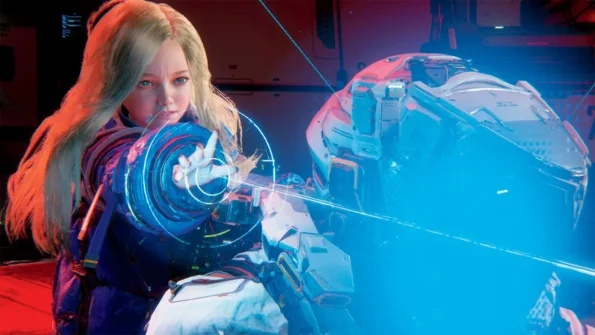
That’s because the gameplay is where Pragmata earns its keep. This is where Capcom throws caution to the wind and delivers something that is equal parts genius and madness. Combat is a strange hybrid of third-person shooting and real-time puzzle-solving. While Hugh handles the guns, Diana hacks enemy armour via a grid-based puzzle system that you must solve on the fly. Yes, during combat. Yes, while things are actively trying to kill you. It sounds ridiculous, and it absolutely is, but it works.
There’s a rhythm to it once you get past the initial “what on earth is happening” phase. You’re dodging attacks, lining up shots, and simultaneously solving these hacking puzzles to weaken enemies. It’s chaotic, demanding, and at times downright brutal. But it’s also incredibly satisfying when it clicks. Few games demand this level of multitasking, and even fewer pull it off without collapsing under their own ambition. I am pretty sure some future study will show playing this game grows your neural connections or some other neural benefit.
Weapons, thankfully, are straightforward enough to keep things grounded. You’ve got your standard arsenal of pistols, rifles, and a few heavier options. It’s not about variety so much as about how these tools integrate with the hacking mechanics. Meanwhile, Diana’s role isn’t just a gimmick; she’s central to everything. Without her, you’re essentially shooting at very expensive bullet sponges.
Graphically, Pragmata sits in that awkward space between impressive and inconsistent. The environments, particularly the stark, desolate lunar landscapes, look fantastic. There’s a sense of isolation that the game captures well. However, character models and certain design choices don’t quite hit the same highs. It’s polished, but not groundbreaking, and occasionally feels like it’s playing it a bit too safe visually.
Where Capcom does stumble, quite noticeably, is in world-building. There’s a fascinating premise here, a stranded colony, rogue AI systems, a mysterious child, but the game never fully explores it. You’re given just enough to stay curious, but not enough to feel invested. It’s like being handed a brilliant novel and only getting to read the blurb at the back.
That said, gameplay is the bread, butter, and jam here, and possibly the entire breakfast menu. What I initially thought would be an overcomplicated mess turned out to be the game’s biggest strength. It’s unique, it’s challenging, and most importantly, it’s memorable. In an industry that often plays it safe, Pragmata deserves credit for taking a massive swing.
At around 13–14 hours for the main campaign, it doesn’t overstay its welcome either. In fact, you might find yourself wishing for a bit more, particularly on the story front. There’s potential here for something truly special if Capcom decides to build on this foundation.
So, should you play it? Absolutely. Despite its narrative shortcomings and occasional design missteps, Pragmata is one of those rare games that dares to be different and actually gets away with it.
“}]]