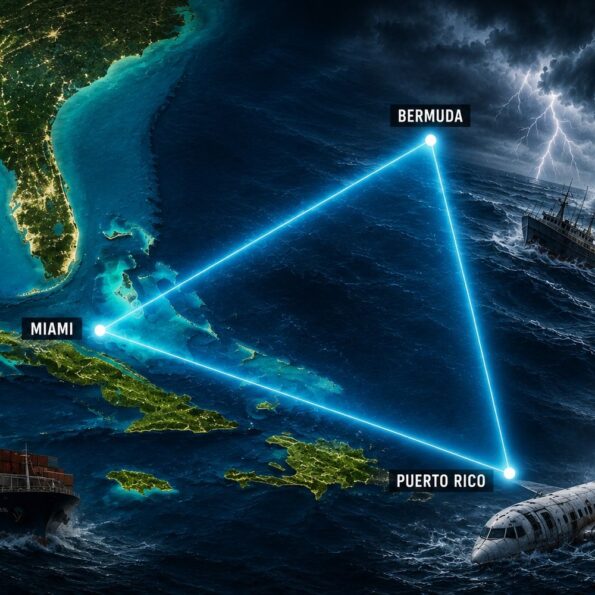
For decades, the Bermuda Triangle has been one of the world’s most famous mysteries. Stretching between Miami, Bermuda, and Puerto Rico, this region became notorious because of stories about ships and airplanes disappearing without a trace. Over the years, these incidents inspired countless theories. Some people blamed alien abductions, others spoke of time portals, magnetic anomalies, or even the lost city of Atlantis. Books, documentaries, and Hollywood films turned the Bermuda Triangle into a global phenomenon and one of the most talked-about mysteries on Earth. But while those legends continue to fascinate people, scientists may have solved a completely different mystery hidden deep beneath Bermuda itself. Researchers have discovered a massive underground rock layer that appears to be supporting the island from below. This finding helps explain why Bermuda still rises above the Atlantic Ocean even though its volcanoes became inactive more than 30 million years ago. What scientists found beneath Bermuda A team led by William Frazer and Jeffrey Park discovered a rock layer more than 12 miles (around 20 kilometres) thick beneath Bermuda. This underground layer is lighter and more buoyant than the surrounding mantle, the hot, rocky material that lies beneath Earth’s crust. Because it is less dense, it acts like a giant floating platform, helping keep Bermuda elevated above the ocean. Why is this discovery unusual?
Most volcanic islands, such as Hawaii, are formed by mantle plumes. These are columns of very hot rock that rise from deep inside Earth and push up the seafloor. Over time, once volcanic activity stops, the uplift usually sinks back down. Bermuda does not follow this pattern. Its last volcanic eruption happened more than 30 million years ago, and there is no sign of an active mantle plume beneath the island today. Yet Bermuda still sits on an underwater bulge about 1,600 feet above the surrounding ocean floor. That unusual feature has puzzled geologists for decades. Also read: AI-powered govt planned on remote island in the Philippines: 17 digital avatars, including Gandhi and Mandela
How researchers made the discovery The scientists used seismic waves generated by large earthquakes around the world. As these waves travel through Earth, they move at different speeds depending on the type and density of the rocks they pass through.
By studying how the waves were recorded at a seismic station in Bermuda, researchers created a detailed image of the underground structure beneath the island. This is how they identified the thick, buoyant rock layer. How the rock layer formed Researchers believe the structure, known as underplating, formed when molten rock pushed into the base of Bermuda’s crust during its volcanic past and cooled there. That lighter rock remained trapped beneath the island and continues to support it, much like a raft floating on water. Some scientists think the material may have originated hundreds of millions of years ago during the formation of the ancient supercontinent Pangaea. What does this mean for Earth science? The discovery suggests that Earth’s interior may be more complex than scientists once believed. Frazer said: Bermuda is an exciting place to study because a variety of its geologic features do not fit the model of a mantle plume. He added that the findings point to other mantle processes that are still not fully understood. Also read: Google I/O 2026 event: First search upgrade in 25 yrs, new AI shopping mate and more
Does this explain the Bermuda Triangle? Not exactly. The research does not solve the legends about disappearing planes and ships. Instead, it explains a geological mystery: why Bermuda remains above sea level despite having no active volcanic system underneath it. This hidden rock layer gives scientists a new way to understand how islands can remain elevated for millions of years. It may also lead to similar discoveries beneath other islands around the world.