[[{“value”:”
For decades, media and pop culture have imposed an oppressive ideal of how women should look. The body positivity movement counters simply: love your curves, reject thinness, and embrace your size. However, for butch and masculine presenting queer women in India, the war with the body has rarely been limited to weight. It`s been about something the movement hasn`t quite found language for yet: the violence of being forced into a femininity that fits like a second skin that isn`t yours.
While body positivity merely scratches the surface of what oppresses women, body neutrality quietly asks something deeper — that we stop letting our bodies determine our worth.
This International Lesbian Visibility Day, four lesbians speak about the version of body neutrality they had to build from scratch, without a blueprint, and the hard-won decision to stop performing for other people`s comfort.
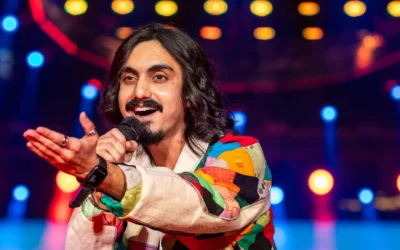
Growing up in Gujarat, Henry shift to a masculine style wasn`t a fashion choice and more a declaration
Permission to exist without performing
Henry (name changed on request), 24, describes expectations familiar to anyone raised in a traditional Indian household, saying, “Long hair, soft features, feminine clothes, and always ‘presentable’ in a very traditional sense. There was this quiet pressure to look delicate and pleasing.”
Growing up in Gujarat, her shift to a masculine style wasn`t a fashion choice and more a declaration. “Switching to a more masc style felt like I finally gave myself permission to exist without constantly performing femininity. It wasn`t just about clothes, it was about control. I stopped dressing for approval and started dressing for comfort and identity,” she reveals.
In a culture that judges women by what they wear, choosing clothes is not about style anymore. It becomes a repeated act of resistance. Henry`s relationship with mainstream body positivity reflects this gap. “Honestly, mainstream body positivity still feels limited. It talks a lot about size, being curvy or thin, but not enough about expression. For me, `looking good` has nothing to do with fitting into a body type. It`s about alignment, when how I look matches how I feel inside,” she observes. Not finding her place in the movement, she did what many queer women in India quietly do: she built her own version of it. “My confidence comes from authenticity, not validation.”
The safety calculation
For queer individuals in India, the body is a site of constant assessment. In public spaces, on public transport, in family gatherings, the way it is read and misread carries consequences.
Henry talks about the never-ending mental evaluation of safety, “Yes, there are moments when I consciously tone it down. Not because I want to, but because safety comes first. It`s a constant balance. I`ve learned to read spaces.” The awareness is exhausting and intimate, a running internal commentary that never fully powers down. “Some days I show up fully as myself, unapologetic. Other days, I make small adjustments, but nothing that takes away who I am, just enough to feel secure. It`s unfair, but it`s also a reality I navigate with awareness.”
Saven, 19, a non-binary lesbian and freelance book editor who was raised in Kerala, understands this calculus viscerally and has chosen a different response to it. “I don`t dim my light. In fact, I change my look to gayer to rage bait them. There`s a lot of talks going on, but it`s fun,” she says animatedly. There`s something deliberately defiant in this. Where Henry reads the room and adjusts, Saven refuses the reading altogether.
But Saven also knows when the situation shifts from politics to survival. “I do easily pass off as a guy at bus stations at night when I come back after meeting my fiancee, and as you guessed, that`s a lot safer.” Passing, here, is not aspirational. It`s essential when physical safety might be at stake.
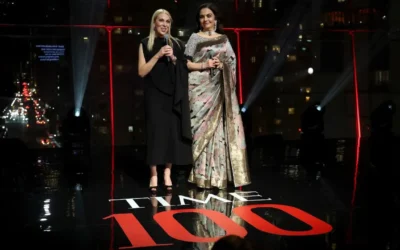
Anuradha says the closest label she would accept is androgynous
When there is no box
Anuradha Mathews is 41, based in Noida, and has spent her career producing films and television across Asia. She speaks with the clarity of someone who has had decades to understand herself and considerably less patience for those who can`t keep up.
The story of her style is inseparable from grief. “To be very, very blunt, the moment I really stopped wearing all the women`s clothes is after my mom passed away. I was 18. Before that, I was forced to wear sarees and kurti tops, which I hate. I felt very uncomfortable. You hardly see me smiling.” For a time, she returned to herself, then family pressure pulled her back. It wasn`t until her late twenties, when she came out to herself as gay, that her style broke definitively from expectation. “I started wearing veshti and shirts, and there was no going back. I was completely in love with the attire and felt more confident,” she admits.
But India is a different terrain from the rest of Asia where she`s worked. She faced no issues in Singapore, Thailand, Vietnam, or even on Indian film sets. Outside the set, on the street, in her own society, it`s a different story. “I had to let go of my favourite shorts, singlets and sleeveless T-shirts. I have a short haircut and tattoos, and people really stare, which makes me very uncomfortable.”
However, she navigates a specific brand of misreading, “I`m not a butch. I don`t bind my breasts. I am very feminine inside. I`m just not feminine in my choice of clothing.” When people, including close friends, ask if she plans to transition, she explains, patiently, then simply stops. “After that, I just let it be. Whatever you think, you think.”
The closest label she`d accept is androgynous. “I like feminine earrings, chunky chains, lip gloss, and a beautifully tailored suit. There`s no box for me,” she declares. The refusal to be boxed isn`t merely defiance, it`s accuracy. The expectation that she fit into butch, femme, or trans definitions is a kind of violence that doesn`t leave marks.
The quiet moments that actually count
What does body neutrality look like? Not the movement`s version, not the influencer`s version but the actual, private version?
For Henry, it arrives in mundane invisibility. “It`s usually in very quiet moments, not big ones. Recently, I remember walking alone, headphones on, completely in my own world, not thinking about how I looked, who was watching, or how I was perceived. I was just there,” she confesses. That is the benchmark she has set for herself. Not joy or pride, simply the absence of self-consciousness.
Her everyday anchor is smaller, more tactile. “The moment my hair is exactly how I like it, everything shifts: my posture, my confidence, even the way I walk. It sounds small, but it changes how I carry myself completely,” she says.
Saven`s transformation has been quieter still and woven into love. Her fiancee, a model with impeccable taste, has gently expanded Saven`s palette. “I was all black, navy blue until a year ago. My partner has healed so much that she hasn`t broken. I started being comfortable with softer shades.” That`s the interesting thing about body neutrality in practice: it isn`t fixed. It shifts and evolves and makes room for pink and yellow when someone you trust chooses them for you.
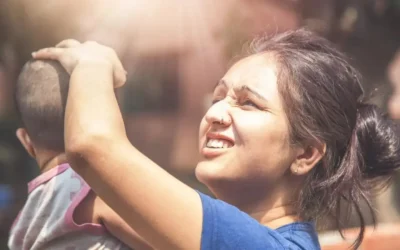
Saven`s transformation has been quieter; Megha’s neutrality is a precise renegotiation
The thinking person`s body neutrality
Megha Basu, 26, speaks from a wider frame. The Kolkata resident is interested in understanding the structure of the pressure itself, not just her own navigation of it.
For Megha, the template itself is unstable, “Masculinity isn`t one fixed template. It shifts across cultures, generations, and even social circles. What`s considered `tough` or `manly` in one group might not matter at all in another.” The box is presented as universal, even though it never is. A lot of people, including men, quietly feel suffocated by expectations they never agreed to.
Megha’s neutrality is a precise renegotiation. “It`s not about ignoring appearance but not letting appearance dominate my self-worth. I can still care about how I look, style myself, or have preferences, just without tying it to my value as a person.”
Body neutrality is not about eliminating aesthetic desire but preventing it from becoming the standard by which a person’s worth is measured. You can want a good haircut and still not need it to justify your existence.
To those subjected to the relentless expectations of conformity to gender norms, she advises, “I wouldn`t tell them to `just ignore it` — because in a place like India, those expectations around gender and appearance are loud, persistent, and often enforced in everyday life. Feeling like you don`t fit those boxes isn`t a personal failure, it`s a sign that the boxes are narrow.” It’s a simple reminder, but after years of being told otherwise, it`s the most radical thing you can say.
To break a box, sometimes you have to explode it. For Megha, that icon is Ranveer Singh. “His wardrobe talks about maximal, fearless, high-visibility masculinity. He’s someone who treats clothes like expression, not rules.”
The radical act of alignment
Ask any queer, and the amount of constant unlearning they have to do would leave any cis-heterosexual person questioning everything they’ve taken for granted. None of these women arrived here easily. Henry admits, “It wasn`t an overnight change. It took me time to unlearn what I was taught and slowly become comfortable showing up as myself.”
Anuradha, at 41, built her version of South Asian masculinity on her own terms: veshti, tailored pants, folded sleeves, a bow tie, and the ability to walk into high-stakes meetings knowing exactly who she is. Saven is still becoming, at 19, with a fiancee who picks the colours.
Anuradha`s advice for queer women experimenting with masc expression is generous. “The moment you feel good in what you`re wearing, the confidence just follows. The way you carry yourself, the way you walk into a room, the way you talk — it all shifts.”
Across four cities and four very different journeys, they all seem to be working toward showing up without having to justify it. What mainstream body positivity hasn`t quite grasped is that for queer women navigating masculinity in India, the goal was never really about looking good in the mirror. It was about no longer being a performance but dressing for yourself. “You don`t have to shrink yourself to fit into anyone else`s idea of you,” Henry concludes.
“}]]