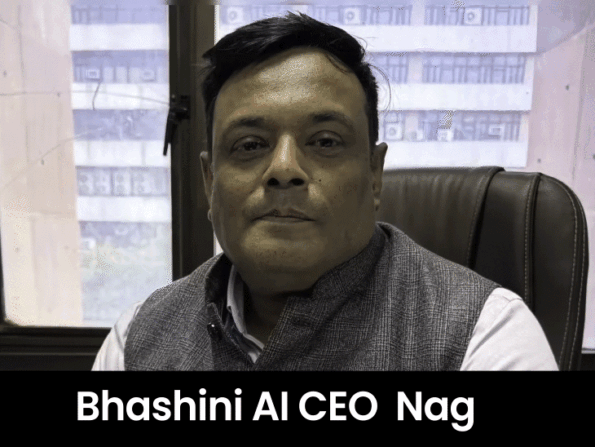
National Technology Day is being celebrated in India on May 11. On this occasion, the Directors of IIT Kharagpur, IIT Delhi, IIT Madras and the CEO of Bhashini, the Government of India’s AI-based translation platform, shared their ideas and experiments about advancing technology in the era of Artificial Intelligence (AI) and its reach to common people. IIT Kharagpur Director Prof. Suman Chakraborty said that AI should not remain limited to just laptops and chatbots. Its use extends to fields, clinics, factories and villages. IIT Delhi Director Dr. Rangan Banerjee said that about 100 faculty members of their institution are working on AI projects related to healthcare. IIT Madras Director Prof. V Kamakoti said that AI can play a major role in providing quality education to the country’s 300 million (3 crore) students. Bhashini AI CEO Amitabh Nag said that the biggest challenge for technology in India is not the internet, but language. Read the opinions of all four personalities in sequence: “AI should not remain limited to just laptops or chatbots. Its real work is to reach farms, clinics, factories and villages. At IIT Kharagpur, we are working in this direction. The work of bringing AI to the ground. Our platform is AI4ICPS (Technology Innovation Hub). Its goal is to directly connect AI with everyday problems. We have made several major innovations in the healthcare sector and created devices. AI is creating these 4 essential devices in the healthcare sector We have created AI robots for farming, which can go to the field and observe crops themselves, identify diseases and apply medicine as per requirement. In the health sector too, we have created many low-cost diagnostic tools. This is a paper-based strip and mobile phone-operated system. A small blood sample drop from the patient is placed on the strip, then the mobile camera takes its reading. AI analyzes that data and immediately tells whether there is blood deficiency or not. The advantage of this is that there is no need for a lab, machine, or large setup. Testing can be done even at Anganwadi centers, schools, or village health camps. This is a handheld device that looks like a torch. It is used by shining light inside the mouth, where early signs of cancer can be identified with the help of AI. Our entire focus is on reducing costs. The oral cancer device will cost less than 500 dollars (approximately ₹40,000). It will not require much training or infrastructure to operate.
This is a private and easy screening tool for women, especially for cervical health. This is also a strip and mobile-based system, in which women can take samples themselves and test. The biggest advantage is – privacy and convenience. Early screening happens without going to the hospital, which helps detect disease early. This is a small device that can test for infectious diseases like TB. Usually, such tests require large lab setups and time, but this device is designed to deliver results quickly with minimal resources. This makes early detection of TB possible in villages and mobile health camps. IIT Kharagpur has developed ‘RoboFarm’ for fields. Tasks ranging from identifying crop diseases to spraying the right amount of pesticides are being done through automation. Diseases in crops can be identified through camera-based analysis. IIT Kharagpur presented an AI-based Unmanned Ground Vehicle (UGV), which has been developed by its incubated startup Edgeforce Solutions. It can be operated without a driver. Its normal operating range is up to 5 kilometers. It can carry weight up to 500 kilograms.” 2. Professor V. Kamakoti, Director of IIT Madras “I often think about one thing: Is quality education reaching every child in our country? And if not, what can technology change in this? There are about 25 crore children in the school system in our country and 5 crore students in higher education. Providing equal quality education to every child at such a large scale is not easy. But AI can make this possible. IIT Madras is playing a role on 4 major fronts in this: We have recently launched Bodhan AI. Its purpose is that every child in the country should get better education. Under this, every student will get an AI companion, which will answer their questions while studying, explain where they don’t understand, and identify their weaknesses and help them study accordingly. We have launched a plan to provide AI training to 10 lakh teachers so that they can use technology correctly. This will enable teachers to create better lesson plans, check copies quickly and accurately, and understand each child’s progress through data. We have been working on the Shakti microprocessor program for a long time, whose objective is to build India’s own processor. Today India is very strong in terms of design. IIT Madras and other institutions are preparing hundreds of chip designs every year. Now the next step is to manufacture chips in the country itself. A plant with 28 nanometer technology is being built in Gujarat. After it starts, in the next 1-2 years India can meet about 90% of its needs on its own. IIT Madras is also working on photonics and display technology, which could transform our everyday gadgets in the coming times. Photonics means transferring data rapidly through light. This will increase internet speed and make networks more efficient. Meanwhile, AMOLED display technology improves mobile screens with brighter and clearer displays with less battery consumption.” 3. Dr. Rangan Banerjee, Director of IIT Delhi “We want the facilities that are currently limited to big hospitals and specialist doctors to reach the primary health centers in villages. At IIT Delhi, we have around 600-650 faculty members, of which approximately 100 are working on different healthcare-related projects. In collaboration with AIIMS and other hospitals, we are creating 4 such solutions that will directly benefit people. We are working with AIIMS on an AI-based cancer detection system. The special feature of this technology is that it does not require a radiologist every time. The accuracy is close to that of specialist doctors and large-scale screening can be made possible. We are working on ‘cobotics’ i.e. collaborative robotics, where machines and humans work together. Research is being conducted on technologies like medical robotics, medicine delivery, robotic surgery. The aim is to make treatment more accurate, safe and accessible. In the field of environment, we have developed LC3 Green Cement, which has approximately 50% less carbon emissions compared to traditional cement. But the strength and usage remain almost the same. This technology has been trialed in 25 countries, meaning it is being accepted at the global level as well. Apart from this, in the ‘Coal to Methanol’ project, coal is being converted into green methanol, while carbon dioxide is being captured. IIT Delhi has developed an AI-based SCADA (Supervisory Control and Data Acquisition) for railway and metro networks. This is useful in train operations. Under this system, AI can predict failures in advance by analyzing data from tracks, wheels, and overhead wires.” 4. Amitabh Nag, CEO of Bhashini “The biggest challenge for technology in India is not the internet, but language. If a person cannot understand the system in their own language, how will they benefit from digital services? With this thought, we are working on Bhashini. Bhashini is built according to India’s languages and dialects. It better understands local context and words. It is directly integrated with government systems. Bhashini’s biggest focus is that people can use services in their own language. Today there are 79.8 crore people in the Public Distribution System and about 20 lakh interactions are happening in their own language every month. At the village level, there are platforms like e-Gram Swaraj and Sabhasar. More than 3 lakh Gram Sabha meetings are recorded and being used in 1.28 lakh panchayats. Bhashini’s tools are not limited to just one app today. Used on over 800 government platforms. 1.5 to 2 crore AI processing daily. Supports 36 text languages. Has 23 voice languages and 35+ international languages as well. The impact is that farmers are able to get advice in their own language. Patients are able to communicate better with doctors. Students are able to understand their studies in their own language Now we are working on the next phase. We are creating multilingual audiobooks and real-time transcription and translation tools. This will enable students to listen to content in their own language… meetings, classes or government conversations will be understood immediately and people of different languages will be able to talk without interruption. This will begin in the rollout phase, meaning these tools will gradually reach common people in the coming time. We are creating tools where people can ask questions by speaking… the need to read and write text is reduced. It can work even with low internet. The benefit of this is that a farmer can get advice directly in their own language. A person can understand government schemes and digital systems become much easier.”